Super Smash Bros. Melee - you’ve probably played it at some point. It’s the best selling Gamecube game of all time, after all.
The Game
The Game
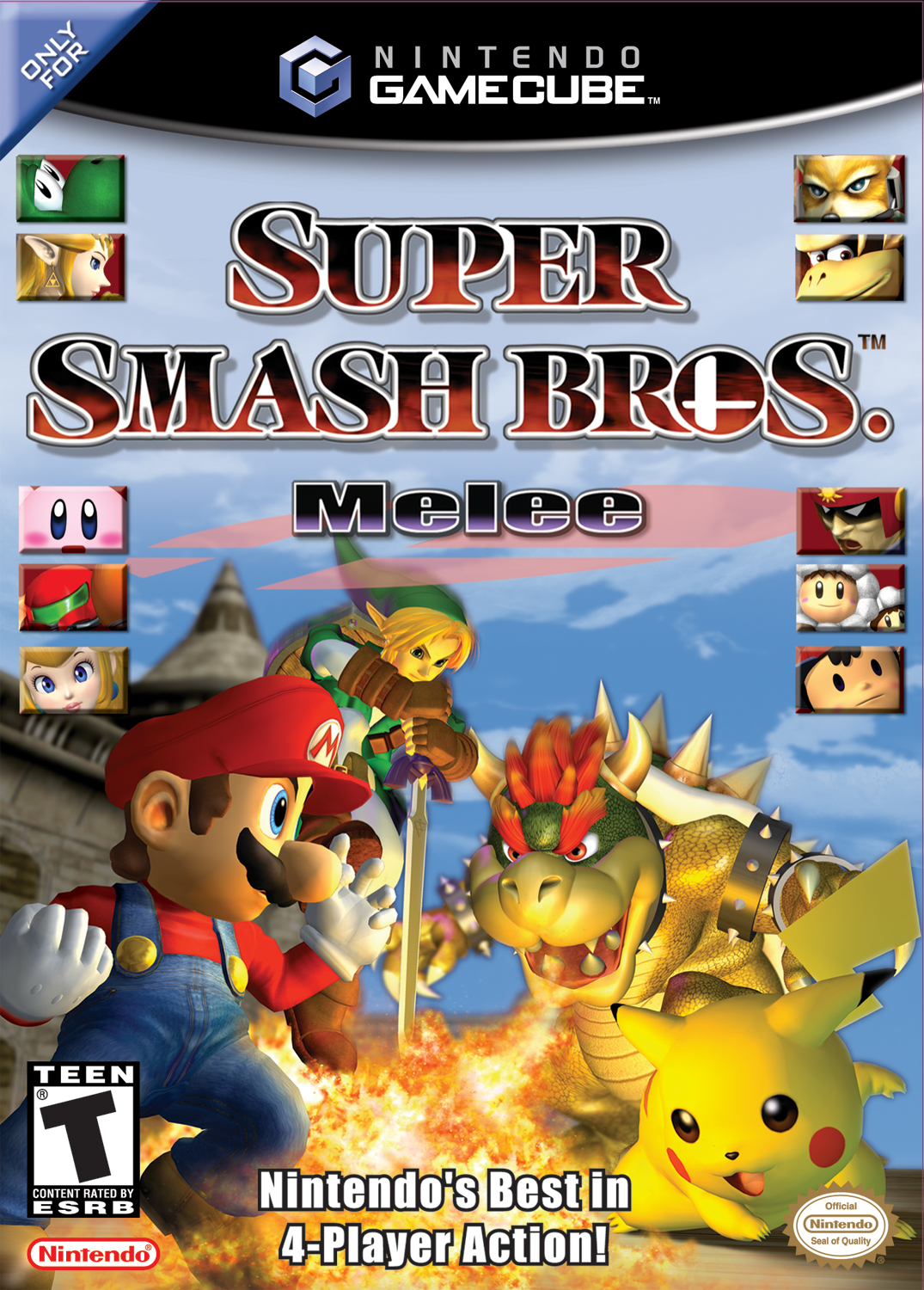
The game is part of the Super Bros. franchise, which is comprised of the original Super Smash Bros. (N64), SSB Brawl (Wii), and SSB for 3DS/WiiU. At the most basic level, the Smash Bros. games share the same underlying ideas. They aren’t traditional fighting games, which require players to deplete health bars. Instead, they require players to knock each other off the stages into the blast zones on top, sides, and bottom. The overall gameplay in each game is somewhat similar in that players have lives (stocks) and that the games are very platformer-inspired. They also share many of the same characters on their rosters and a number of the stages have been repeated throughout the series.
However, the games are all very different on a deeper level. In short, the emphasis in melee is fast, precise movement that creates openings and leads to short improvisational combos. Because the game is so fun and rewarding, a thriving competitive scene has developed.
However, the games are all very different on a deeper level. In short, the emphasis in melee is fast, precise movement that creates openings and leads to short improvisational combos. Because the game is so fun and rewarding, a thriving competitive scene has developed.
The Scene
The scene has never received direct support from Nintendo, unlike other games who do from their creators. This is probably because Nintendo wants to keep the image of their games as geared towards “everyone”, not just the competitive gamers.
The game was not designed to be competitive, but rather a party game - the designer has even said so. Because there were accidental ‘glitches’ that allowed for the development of advanced techniques, it became quite the platform for a test of skill.
There was a decent level of competition from when the game first came out in 2001. For a period of time in 2008, Melee was not popular at all due to many players flocking to Super Smash Bros. Brawl, but that was short-lived due to people finding that Brawl was a lot more...slow-paced and not as fun to watch/play.
4 stocks, no items, only certain stages allowed - these core rules reduce the chance of randomness and hazards, which would hinder the main purpose of competition - to determine the better player.
Why has it stuck around after >15 years?
-The game allows you to express yourself through the actions of your characters ex. creative combos (certain combos are so iconic that they have names).
-Since there’s not much money that is going around in this scene compared to that with other games (LoL, CS, etc.), the players really do it for the love of the game, which makes a huge difference in terms of self-starting in growing the scene.
-It’s impossible to master, yet easy to improve.
-The game is aesthetically pleasing and beautiful to watch at the top level.
-The competitive scene is basically like a really entertaining reality show, which I will go into later.
Melee is still growing! The recent documentary really injected life into the scene, and tournament entrants are breaking all-time records after 15 years. Players are still getting faster and more precise.
As for regional differences, the USA is the best country by far. Probably only 5-6 players in the top 100 are not from the US. Within the US, there is a strong rivalry between regions...I’d rank them in terms of overall skill as 1) SoCal 2) Florida 3) NorCal.
It’s funny because you can actually tell where someone is from by their playstyle ex. East Coast Falcos emphasize lasers while West Coast Falcos rely more on physical attacks. This is just due to habits being passed down from mentors to mentees in training, and because styles and ways to play the game have to be developed offline since there is no online multiplayer mode for the game.
The Players

It’s basically a reality show with a motley of characters and personalities. Tournaments are the biggest emotional roller coasters I've ever experienced, no lie.
There’s a huge gap between even the top players. I’d say that the Top 6 players right would beat (in a set of 3, not just one single game) #10 90% of the time, #10 would beat #50 90% of the time, #50 would beat #100 90% of the time.
How would the average person ex. me or you do against a top 100 player? Probably wouldn't be able to hit/damage him once, let alone take a stock.
The top 6 players are clearly a cut above the rest right now. Let me give you a brief background of each of them, I listed them by their current ranking IMO:
Mango - Californian Fox/Falco, probably the GOAT (greatest of all time), became a father at 21, goofy/charismatic
Armada - Swedish Peach/Fox, stone-cold iron will and determination
PPMD - North Carolinian Falco/Marth, intellectual and analytical
Leffen - Swedish Fox, rapid ascension over the past few years, “bad boy” image/talks a lot of trash
Hungrybox - Floridan Jigglypuff, strong mental game, has an engineering career outside of smash
Mew2king - New Jerseyan Marth/Sheik, plays all the smash games really well (unique to these 6), diagnosed with Aspergers
What separates these players from the rest? I think it has to do with their mental game. There are two components to success in any game or sport - the physical game and the mental game.
What separates these players from the rest? I think it has to do with their mental game. There are two components to success in any game or sport - the physical game and the mental game.
Everyone at the top level generally has the technical skills to press buttons quickly, but much rarer is proper decision-making and a healthy psychological mindset. It comes down to avoiding going on tilt (making poor decisions when you’re flustered) and avoiding choking under pressure (hundreds of people watching/judging every move).
Even the best falter at times, but these 6 are just so much more consistent than the rest.
I don’t play as often as I like (don’t have a TV), but I’m proud to be a fan of this game.
If you want an example of top high-level play of two players both on point, watch this or this. If you want an example of why people get so hyped over the game, watch this.


No comments:
Post a Comment