Sunday, November 15, 2015

For the Love of the Game

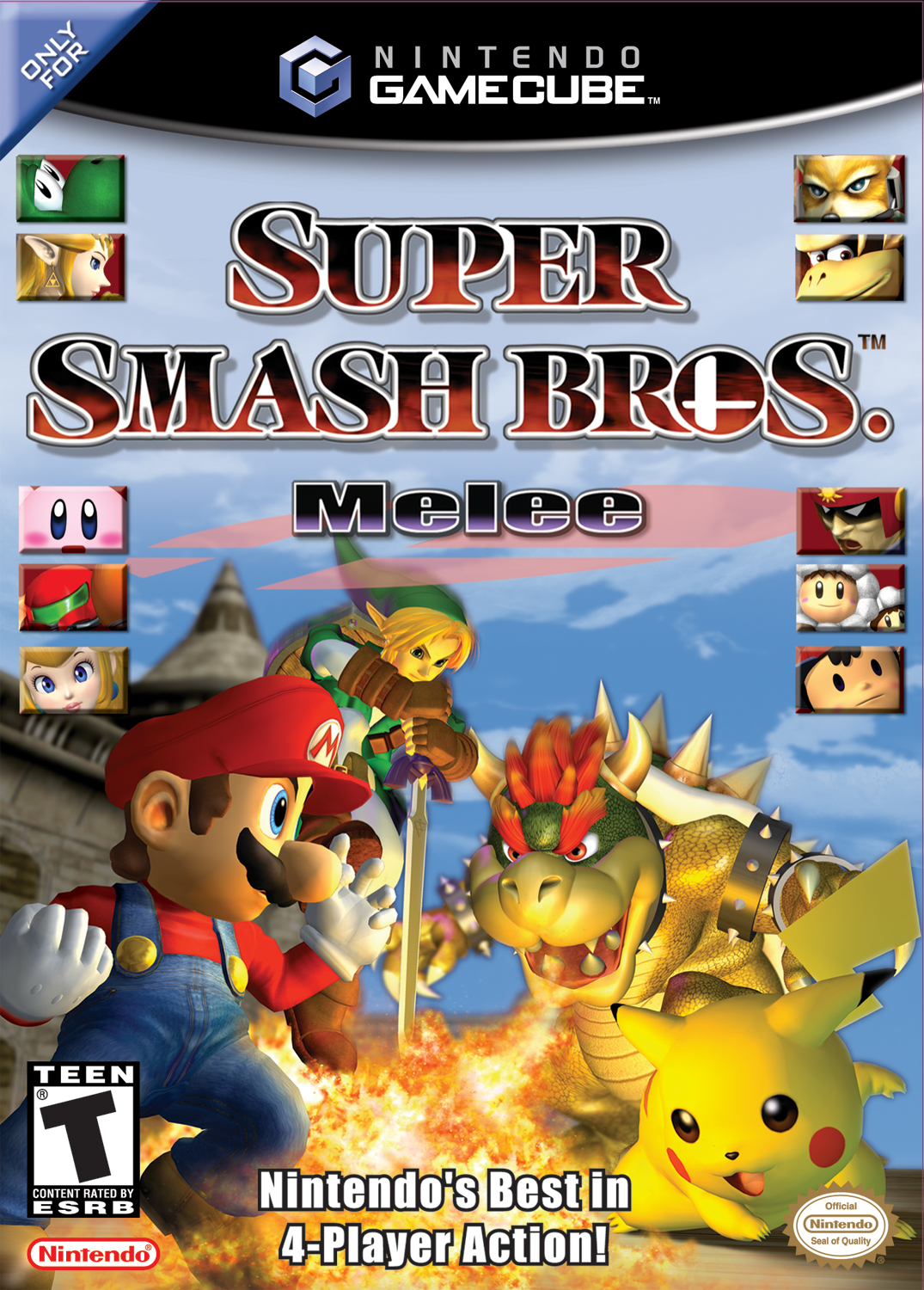
Super Smash Bros. Melee - you’ve probably played it at some point. It’s the best selling Gamecube game of all time, after all.

The Game

The game is part of the Super Bros. franchise, which is comprised of the original Super Smash Bros. (N64), SSB Brawl (Wii), and SSB for 3DS/WiiU. At the most basic level, the Smash Bros. games share the same underlying ideas. They aren’t traditional fighting games, which require players to deplete health bars. Instead, they require players to knock each other off the stages into the blast zones on top, sides, and bottom. The overall gameplay in each game is somewhat similar in that players have lives (stocks) and that the games are very platformer-inspired. They also share many of the same characters on their rosters and a number of the stages have been repeated throughout the series.

However, the games are all very different on a deeper level. In short, the emphasis in melee is fast, precise movement that creates openings and leads to short improvisational combos. Because the game is so fun and rewarding, a thriving competitive scene has developed.


The Scene

The scene has never received direct support from Nintendo, unlike other games who do from their creators.  This is probably because Nintendo wants to keep the image of their games as geared towards “everyone”, not just the competitive gamers.

The game was not designed to be competitive, but rather a party game - the designer has even said so. Because there were accidental ‘glitches’ that allowed for the development of advanced techniques, it became quite the platform for a test of skill.

There was a decent level of competition from when the game first came out in 2001. For a period of time in 2008, Melee was not popular at all due to many players flocking to Super Smash Bros. Brawl, but that was short-lived due to people finding that Brawl was a lot more...slow-paced and not as fun to watch/play.

4 stocks, no items, only certain stages allowed - these core rules reduce the chance of randomness and hazards, which would hinder the main purpose of competition - to determine the better player.

Why has it stuck around after >15 years?
-The game allows you to express yourself through the actions of your characters ex. creative combos (certain combos are so iconic that they have names).
-Since there’s not much money that is going around in this scene compared to that with other games (LoL, CS, etc.), the players really do it for the love of the game, which makes a huge difference in terms of self-starting in growing the scene.
-It’s impossible to master, yet easy to improve.
-The game is aesthetically pleasing and beautiful to watch at the top level.
-The competitive scene is basically like a really entertaining reality show, which I will go into later.

Melee is still growing! The recent documentary really injected life into the scene, and tournament entrants are breaking all-time records after 15 years. Players are still getting faster and more precise.

As for regional differences, the USA is the best country by far. Probably only 5-6 players in the top 100 are not from the US. Within the US, there is a strong rivalry between regions...I’d rank them in terms of overall skill as 1) SoCal 2) Florida 3) NorCal.

It’s funny because you can actually tell where someone is from by their playstyle ex. East Coast Falcos emphasize lasers while West Coast Falcos rely more on physical attacks. This is just due to habits being passed down from mentors to mentees in training, and because styles and ways to play the game have to be developed offline since there is no online multiplayer mode for the game.


The Players


It’s basically a reality show with a motley of characters and personalities. Tournaments are the biggest emotional roller coasters I've ever experienced, no lie. 

There’s a huge gap between even the top players. I’d say that the Top 6 players right would beat (in a set of 3, not just one single game) #10 90% of the time, #10 would beat #50 90% of the time, #50 would beat #100 90% of the time.

How would the average person ex. me or you do against a top 100 player? Probably wouldn't be able to hit/damage him once, let alone take a stock.

The top 6 players are clearly a cut above the rest right now. Let me give you a brief background of each of them, I listed them by their current ranking IMO:
Mango - Californian Fox/Falco, probably the GOAT (greatest of all time), became a father at 21, goofy/charismatic
Armada - Swedish Peach/Fox, stone-cold iron will and determination
PPMD - North Carolinian Falco/Marth, intellectual and analytical
Leffen - Swedish Fox, rapid ascension over the past few years, “bad boy” image/talks a lot of trash
Hungrybox - Floridan Jigglypuff, strong mental game, has an engineering career outside of smash
Mew2king - New Jerseyan Marth/Sheik, plays all the smash games really well (unique to these 6), diagnosed with Aspergers

What separates these players from the rest? I think it has to do with their mental game.  There are two components to success in any game or sport - the physical game and the mental game.
Everyone at the top level generally has the technical skills to press buttons quickly, but much rarer is proper decision-making and a healthy psychological mindset. It comes down to avoiding going on tilt (making poor decisions when you’re flustered) and avoiding choking under pressure (hundreds of people watching/judging every move).

Even the best falter at times, but these 6 are just so much more consistent than the rest.

I don’t play as often as I like (don’t have a TV), but I’m proud to be a fan of this game.

If you want an example of top high-level play of two players both on point, watch this or this. If you want an example of why people get so hyped over the game, watch this.

Sunday, October 25, 2015

A Tale of Two Cultures

This post was quite difficult to write...as in, tough to convey thoughts, because these complex topics are impossible to fully understand…and I still think it’s pretty unrefined so please bear with me.  I’m going to attempt to talk about how two modern countries, China and the US, have been shaped by a historical, fundamental aspect of their respective cultures.  So this post is divided into 2 parts.

There are so many aspects of Chinese culture to talk about, but I want to focus on the people’s view of the modern government.  To preface, Confucian ideals are the building blocks of Chinese culture. With regards to government, I think that two virtues especially translate: filial piety, which is respect for one’s parents/elders no matter what, and social harmony, which can be achieved if everyone just fulfills their role in society.

To understand the last century of Chinese history, you have to know what happened in the thousands of years before then.  In short, Chinese history is filled with conflict – thousands of years of internal/external wars, as well as frequent occupation by outsiders.  Mao is one of the most controversial political leaders in history due to his harsh policies…but only outside of China.  It’s easy to see why Chinese people look up to him, if you consider the situation from their perspective (which incorporates both culture and history).

One main reason Mao is revered by the people is due to Confucian virtues…to always respect your elders despite the circumstances.  The cultural revolution and great leap forward caused a lot of strife in the country…but most people were okay with it.  He is likened to the American president Andrew Jackson, because for all his questionable actions, his motivation revolved around progress for the country as a whole.  This is why even though the current president, Xi, was separated at a young age from his father, who was detained/exiled by Mao’s army, he still respects him and abides by his policies since Mao is the “father of the country,” just like children are taught to respect their parents above all else.  In addition, Mao is revered because of the nation’s before/after story – he laid the foundation for today’s China by unifying the country (especially the farmers/industrial workforce) and saved China for the “shame” of occupation of invasion that for so long had plagued the nation. What’s ironic, though, is that the selfless ideals of Confucianism have really been cast aside by the massive influx of consumerism in today’s China. But that’s a topic for another day…

Okay next topic is a bit more heavy…but I feel I understand it a lot better, being that I actually grew up in the country I’m talking about…

I don’t need to name any specific incidents, but there have been a lot of US violence-related shootings lately, especially in the last ~5 years.  After every incident, you find the same 2 topics of discussion hammered over again and again: gun policy and mental health treatment.  The question is often asked, “why do these things happen in this country more so than in others?”

My opinion is that the core reason doesn’t have to do with guns, nor mental health…but rather the inherent culture/image of the US.

It has been reported that the US has 31% of the world’s attackers, but when narrowed down to workplace or school shooters, the US has…62% of global attackers.  I don’t think that the huge jump in these two specific places, workplaces and schools, is coincidental – they definitely mean something more.

“The American Dream” is an incredibly individualistic philosophy that basically guarantees “success” in this country as long as one works hard enough in this “land of opportunity.”  But equality of opportunity is often misconstrued to imply equality of outcome as well; this concept is sometimes warped into Americans feeling entitled to success.

If you look at the motivations of perpetrators, they have a common theme revolving around how they felt life/”the system” was unfair to them; they didn’t get the attention, praise, etc. they felt they “deserved.”  They feel that society has been unfair to them, which leads to a lot of built up anger, manifesting itself in mentally unstable people (“the who”) in dangerous ways (“the how”).  But as for “the why”…fame is thought of as end unto itself; after someone struggles with high aspirations, they blame others.  Schools and the workplaces are the symbolic venues where the “American Dream” is achieved, as this is where people progress in their academic and career pursuits – thus unfortunately becoming “fitting” venues of “revenge” for these shooters.

One abetting, related factor is the explosion of mass media/technology.  People have more access to see what other people are up to, and what other people have done.  They see success stories and wonder why they aren’t the ones experiencing that.  Americans do love to compare themselves to others.  This ties to the scientific study that news outlets encourage future actions from similar-minded people (“copycat effect”) by publicizing killers’ names/backgrounds.  The story often becomes more about the perpetrators and less about the victims, and people might think that their “ticket to fame” can come from doing the act. If you took a survey of every country, asking “are you satisfied with your life?” I’m pretty sure the US would rank at the bottom.

The worst part is, I don’t even know what could be done about this fundamental issue, because it’s an ugly by-product tied to our core identities as Americans. On top of all this, there isn’t really a strong sense of unity among countrymen like there is in other countries (Europe especially)…this is due to the unique composition of the nation, racially and ethnically.  The individualistic culture in America has created a steep social and economic pyramid with a superficial layer of “perfection” coated over a latent, deep unrest.  It’s a double-edged sword to believe and act as if we are the “best country.”

Well…so….yeah…a country’s culture determines so much – it can often easily explain why things are the way they are.  Just some thoughts I wanted to put down...well...most of my other posts are more lighthearted, as you can see haha.

Sunday, October 4, 2015

Some Thoughts on Personal Finance

Personal finance is a skill for which everyone is at a different stage. This post is geared towards the 21/22 year old who just graduated from college/is just starting a new job.

Personal finance is as much of a personal, emotional issue as much as a logical, rule-based one. In the end, it’s about taking actions to reduce stress and sleep better at night.

Budgeting

Here’s the template I use, it’s basically a 12-month forecast in which I start off with my paycheck $$ at the top and expenses below.

Take Home Pay
XXXXX
Rent
XXXXX
Food + Drink
XXXX
Transportation
XXXX
Gym + Laundry + Haircut + Exam + Phone
XXXX
Travel
XXXX
Donation
XXXX
Roth IRA Contribution
XXXX
Total Expenses
XXXXX
Remaining $
X

This is just a forecast/goal that I try to maintain.  I’m fortunate enough to be in a position where I don’t have to worry about student loans, but that should take priority if you do.

Emergency Savings - 3-6 months. Your expenses for however long you think it takes you to find another job in case a catastrophe happens.

There are actually checking accounts out there that yield 1-2% interest (Emigrant, ING, AllyBank, GE).

The amount of taxes withheld compared to your actual taxes owed is calculated during mid-Jan to 4/15, and you’ll receive your refund a few weeks after submitting your taxes (or send additional money to the government).

Credit cards

Three types: cash back, travel, low interest
AMEX/Chase have the best IMO.
Try to hit point bonus offerings that CCs have. To hit these bonuses (ex. spend $4k in 3 months to get 40k points), you can...offer to pay for big purchases your parents/friends make, use your CC to pay taxes, buy a huge Amazon gift card, etc.
In my opinion, even though I really don’t like to tell people how to live their lives...there’s no reason to carry a balance (not pay off all of your bill) every month.

Investing

The biggest investment pool in the United States is for retirement.  Pension plans aren’t so popular anymore because they bankrupt companies, but your firm may offer a 401(k) plan, where you contribute X% of your salary.

401(k) are company-sponsored retirement plans. You should at least contribute up to the company match because it’s free money. Limit a year is $18,000 atm.

IRAs are individual retirement accounts set up by yourself. Limit a year is $5,500.  

Each of the above have two types: traditional and Roth. Traditional means it’s deducted from your base salary (before tax), like your social security taxes for example. However, when you withdraw the money at age 60, you will have to pay taxes.  Roth means it’s deducted from your after-tax amount, so you’ve already technically paid taxes on it already, but when you withdraw it, you won’t have to pay taxes.  There is a penalty for withdrawing the money before you turn 60 years old.  For young folks, it’s been suggested that the Roth type is the way to go because assumingly, you’re in the lowest tax bracket right now, so you should pay the tax now rather than later when you will be in a higher tax bracket in the future. You can open an IRA account with Vanguard, Fidelity, etc.

For younger people, you may want to set up both a Roth 401(k) and Roth IRA. Unless contributing to a traditional 401(k) can bump you down to the next lowest tax bracket. Also, you are currently not allowed to contributed to a Roth IRA if you make over a certain amount (6 digits). However, there is currently a loophole where you can contribute to a traditional IRA, and then immediately convert it to a Roth IRA - don’t ask me why that’s still okay...

Only invest in stocks if you are willing to spend significant time researching the companies and industries. Otherwise, you’re pretty much just gambling.

After you’ve set up an emergency fund, you can take the remaining savings and invest it in index funds. Mutual funds are funds that are professionally managed that buy many securities such as stocks and money markets that are funded by people like you. I think the most important factor for people starting out is to look at expense ratios. For example, a mutual fund with a 1% expense ratio means that every year 1% of the fund will be used to cover expenses, which means less money to you.

This post was a pretty general overview, and I realize I'm probably just regurgitating stuff that you can find through a Google search of "basic personal finance" - but if you want to talk in detail about something mentioned above feel free to shoot me a message.

Sunday, September 13, 2015

What is of the Essence

The idea of time has been on my mind a lot ever since graduation about a year ago...I'm kinda fascinated by how quickly/slowly time seems to pass by depending on what's going on in life.

Since the beginning of the year, I've tried to keep a brief 'journal' of each day's activities...jotting down if who + where I meet up with (snippet below).

It's surprising that you can so easily go months without seeing someone, and you don't realize it until you meet up again...Even though I feel I'm relatively proactive in meeting up with people, I consider it accomplishment to meet up with someone every 1 or even 2 months haha.

People do tend to fall under different tiers of 'closeness'...like, there is a clear distinction between people I talk to ~once a week, then ~once a month, then ~once every 2 months, ~once every 6 months, etc.

The weeks pass by really quickly, a month can go by like that...

At least, I hope this will help me to 'slow down' time a bit and will give me something to reflect on at year's end, since self-introspection is something I'm trying to improve on.


Sunday, August 23, 2015

Only in Canada...?

So I was in Canada for vacation the last week of July. In Toronto, I recommend renting a city bike (24 hours = $7). On one day, my friend VK and I biked from our hotel to the harbor; and we wanted to bike across the waterfront and back up to Graffiti Alley (map below - sorry this is the biggest I could get to work). When we got to Graffiti Alley, I discovered that I was missing my wallet; it must have fallen out of my tote bag strapped to my bike while we were biking along the waterfront.  


VK and I decided to retrace our steps on route back our hotel; not surprisingly, my wallet was not seen lying on on the streets/sidewalks on the way back. So I hurried back to my hotel and notified the receptionist that I had lost my wallet which contained my hotel key.

Plot twist - the hotel receptionist notified me that someone had called and reported that he found my wallet. The person left a number which I called, and he told me he saw the wallet fall out of my pocket, but couldn't catch me in time as he was driving. After picking my wallet up, he called the hotel number which was on my hotel key. After I got into contact with him, he was able to stop by my hotel lobby within 10 minutes to drop it off (he drove a mail truck). Nothing was missing in my wallet, and he refused any compensation I offered. I later discovered on my work email that the person had called my employer, since that was listed on my company credit card, and attempted to reach me through that channel as well. I went on the mail delivery company's website and saw an option to send a message to the CEO. Later that day...


So...Canadians are all as honest and nice as that guy is, right?

Sunday, August 9, 2015

Funny Stuff

I have an analogy...I think humor is like spicy food.

If someone grows up eating spicy food, his/her sense of taste will probably be dulled over time, and he/she will need to eat super spicy food when they grow up to get the same level of flavor.

For humor, I grew up reading/watching a lot of comedic stuff - I was exposed to many styles...and so, now I find myself needing something really extreme, or somewhat offensive, for me to find something significantly funny.

Sometimes at work, when I don’t have much to do and I don’t feel like listening to music, I’ll put on some standup comedy.  I especially enjoy the Comedy Central Roasts and yearly Presidential Roasts at the White House Correspondents’ Dinner.  However, it’s hard for me to listen to any single comedian for too long without getting bored. Most comedians like to tell stories, but I’ve found that if I lose interest in a story in the beginning, then the next 5-10 minutes are...not so fun.  

My favorite comedian by far is Anthony Jeselnik (warning: not at all for the people who are sensitive to offensive jokes).  His whole persona is that he’s a guy who doesn't care about offending anyone, and his drawn-out, deadpan execution/delivery is on point. He also usually sticks to one-liners, which helps with the boredom thing I mentioned earlier. According to Wikipedia, Jeselnik is known for his “dark comedy style, which emphasizes misdirection, non-sequiturs, biting insults, an arrogant bearing, and a stage persona that frequently takes amoral stances.”

Huffington Post says there are 9 types of humor: Physical, Self-deprecating, Surreal, Improvisational, Wit-wordplay, Topical, Observational, Bodily, and Dark. I'd say my humor is a combination of Topical, Observational, and Dark.

I wonder when I get older, if what I find funny will change, and if I’ll start liking older comedians more since they’d be more relatable...

Sunday, July 26, 2015

The Personality Test To End All Personality Tests

Ah, the Myers-Briggs personality test. You’re probably familiar with it and have taken it at one point. Although it does have its limitations like any other personality test, it’s the best one I’ve encountered so far.

I actually was given the original book written by Isabel Briggs Myers. The best description of the 4 parts I've found are:
E vs. I: Extroverts cannot understand life until they live it. Introverts cannot live life until they understand it.
S vs. N: Sensors are observant at the expense of imagination. Intuitives are imaginative at the expense of observation.
T vs. F: Thinkers are task-oriented. Feelers are people-oriented.
J vs. P: Judgers look to finish things. Perceivers look to start things.


These are my first impressions of each type – I don’t want to generalize, these are just what first comes to mind when I think of the type.  Wanted to make that clear before you all come running at me with pitchforks...


ISTJ – reserved, dependable, a bit awkward
ESTJ – may appear chill on the outside…but on the inside, not really.  Like to impose views on others, often come into situations stubbornly with a pre-conceived idea how to do things
ISFJ – the most traditional/”keep the status quo” type, neither too hot nor too cold, but can get super moody at times....
ESFJ – the most ‘motherly’ of all the types, can be bossy at times for sure but generally amiable people
ISFP – the most artsy of all the types, whether it be a poet, artist, Instagram-er...
ESFP – the most naturally extroverted of the types, enjoys being in the spotlight and “life of the party”, not so great at keeping promises
ISTP – all that comes to mind is a guy in his own corner building a masterpiece with legos…
ESTP – only type I don’t know anyone personally, but I envision someone who embodies the “work hard, play hard” mentality – with an emphasis on the “play hard”
INTJ – evil mastermind, think very highly of themselves and lowly upon others (keeps this to themselves), usually pretty intelligent
ENTJ – the most natural leaders, hate to admit wrongdoing, easy to get along with as long as you don’t bruise their huge ego, good at negotiating/getting what they want, love to ask “why would you do that”
INFJ – the most mysterious type, non-conformists who just deal with situations differently from most people
ENFJ – the most naturally nice and optimistic people, may be accidentally emotionally manipulative at times but they’re so good at doing it you don’t realize it, and they don’t either
INFP – the type most likely to be found zoning out, inner romantics, very gentle
ENFP – the most passionate type, they feverishly devote themselves to the people and causes they care about, usually disorganized/all over the place though
INTP – people who have a lot of good ideas inside, but not nearly as often apply themselves

ENTP – the type best at expressing opinions/ideas, talented communicators with a curiosity for the unknown, maybe the least organized type though; like, the best idea generators but the worst idea executors

Sunday, July 12, 2015

The Best NFL Game I Have Ever Witnessed

In my inaugural year of following the NFL (first year of fantasy football), I witnessed the greatest game of my lifetime, and it has not been topped to this day after 8+ years.


December 3, 2007 was a bitterly cold Monday night.  The undefeated New England Patriots (11-0) rode into Baltimore to square off against the Ravens (4-7).  Although the teams were headed in different directions, on this night they would produce a terrifically competitive clash for the ages.  


The emotional intensity in Baltimore was insane. There is, of course, the thrill that comes from giving an undefeated team their first loss. What is more, that past week Sean Taylor (RIP), a player on the Washington Redskins, was killed by an intruder in his home.  Since many players on the Ravens also went to the same alma mater (UMiami) and played with Taylor, his number (21) was face painted on their faces, and you could feel that they were dedicating this game “for Sean.” The atmosphere was electric.


This was during my freshman year of high school, so I was trying to fall asleep at the time.  At night, I usually tuned into to the radio to listen to sports (this was before I had any laptop or cell phone to keep track).  But for this game, I just had to sneak downstairs to the TV after halftime and risk getting caught, because the game was so good.


As for the game itself, I don’t know if there’s a point in me narrating all the notable plays, as you can just watch the highlight video.


The final score was a 27-24 Patriots win. Mark Clayton of the Ravens caught a desperation pass as time expired, but was tackled just 2 yards short of the end zone. The Patriots took the lead when Tom Brady connected with Jabar Gaffney on an 8-yard touchdown pass with 44 seconds left, following a couple of calls that went against Baltimore. The Ravens appeared to have stopped the Patriots on fourth-and-1 with 1:48 left in the game, but a timeout called by the Ravens coaching staff gave the Patriots new life. Baltimore appeared to have the Patriots stopped again on the next play, but a false-start penalty gave New England a fourth-and-6 that it converted.


In short, there were lead changes, questionable penalties, and a thrilling finish.  The Ravens gave the Patriots their biggest test until the infamous Super Bowl vs. the Giants.

But on that cold December night (my favorite X-mas song btw), a legendary game was played, one which I will always remember.

Sunday, June 28, 2015

Next Level Tips at NYU

I don’t even go here anymore, but I just had to dump these somewhere before I forgot them. And this may still be relevant for those of you who are still there…

  • Kimmel 7 – Free Printing (no double-sided though) by the Club Budget Office
  • Kimmel 1st floor actually has a bathroom – it’s hidden right before the elevators on the left that will take you up to KMEC.
  • If you're in Stern UC/LC and have to get to KMEC, you don't have to walk up to the first floor and over. There is an elevator in UC past the girls bathroom/Stern IT
  • If all of Stern's rooms seem taken, in my experience, the most UNDERRATED AND OFTEN EMPTY rooms to check out are Tisch 200 and 201.  And even Paulson Auditorium is forgotten about at times, too (good to practice presentations there)
  • Stern printers all with huge lines? No one ever uses the printer in the UC orange lounge near the girls bathroom. Lounge not too bad too. But cell phone reception in that area is nonexistent
  • On NYC streets, if the building number is odd, it’s on the north side; if the building number is even, it is on the south side. East/West refers to relative of 5th ave. Even numbered streets run east; odd run west.